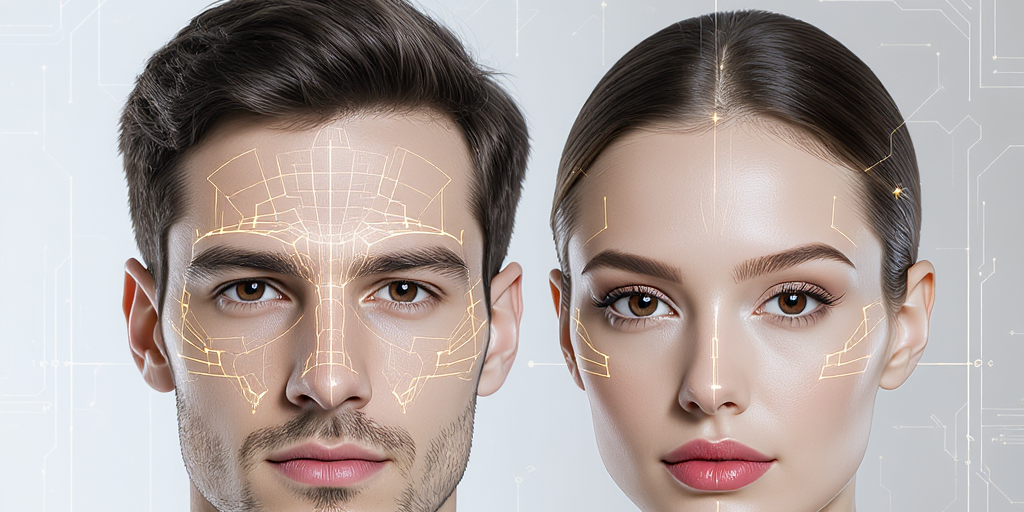

The use of Artificial Intelligence is no longer limited to robotics and automation, it is making its way to our most human aspects, creativity to emotion and now, appearance. The AI Attractiveness Test is one of the most recent technologies that combine both technology and psychology. This is a computer application that purports to scan a face and create an attractiveness rating that is based on data-driven beauty parameters. However, how does AI gauge something subjective like beauty and can it actually become what makes someone attractive?
We will discuss the science, ethics, and psychology of the attractiveness testing of AI-based in this paper, as well as how technology like AIFaceswap are transforming the manner in which individuals interact with online identity and self-disclosure.
What Is an AI Attractiveness Test?
AI Attractiveness Test refers to the use of machine learning models and the facial recognition algorithms to evaluate human faces. Each scan of the features including the symmetry of the face, proportions, skin clarity, and expressions, gives the system a rating or score of attractiveness. These models are developed on extensive databases of human faces with thousands of human faces rated by humans and the AI is able to recognize statistical predictors between facial structure and perceived beauty.
Nonetheless, these AI systems do not rely on individual opinion as compared to the traditional beauty standards. Rather, they are based on quantifiable geometrical and proportional relationships data points that are approximations of what is aesthetically pleasing to humans.
It does not necessarily mean that it is to judge beauty but to objectively evaluate the balance of the face. The score is not the matter of interest to many users but finding out how technology perceives features that a human being tends to perceive without conscious deliberation.
Science of the AI Beauty Scoring
Advanced models of computer vision and facial detectives lie at the center of the AI Attractiveness Test. This is the way these systems deconstruct face features into measurable data:
- Facial Symmetry: Studies in psychology usually associate symmetry with attractiveness because it may be an indication of good health and genetic stability. AI programs scan the facial landmarks (such as eyes, nose, mouth, and jawline) and determine the evenness of the scan.
- Golden Ratio Analysis: There are AI systems that apply the mathematical concept of the Golden Ratio (1.618), considered to be the ideal proportion. The ratio measures the relative distance between important features of the face including the spacing of the eyes or the length of the nose compared to the width of the face.
- Skin Texture and Tone: Image recognition allows the AI to measure evenness of skin tone and texture but this point is controversial and raises ethical concerns because light and camera quality can easily change the outcomes.
- Expression Recognition: Expression of emotion such as smiling may change perceived attractiveness. Other algorithms consider these micro-expressions in order to model the human intuitive response to friendliness or confidence.
Such compound measures provide AI with a multi-dimensional view of attractiveness - although the findings are not universal. The perception of beauty is also culturally, time-related, and personal, which is why AI evaluation is intriguing and restricted at the same time.
Can Artificial Intelligence Genuinely Grasp Human Beauty?
Although the AI Attractiveness Test could have a chance to quantify some physical qualities, beauty is much more than geometrical elements. Human perception entails emotion, culture and personality- aspects which AI cannot fully measure.
As an example, confidence, charisma and personal style are all extremely significant in attractiveness, yet they are almost impossible to quantify effectively by algorithm. A face that is perfect and symmetrical can score very high in an AI test, but even an individual whose features are not symmetrical may be perceived as stunningly beautiful by other people.
In addition to that, cultural bias may be introduced to the training data. In case a given AI system was mainly trained in a specific demographic, it may perceive beauty in a limited way. This leads to another significant question: Is AI strengthening a particular version of beauty, or assisting in expanding our knowledge of it?
The solution is the use of these systems, which are to be used as exploration systems rather than value systems. Treated with wonder and introspection, AI beauty scoring can also act as an interesting reflection of how technology replicates the human mindset.
AI Beauty Testing and its Ethics
The development of artificial intelligence presents both enthusiasm and apprehension to the analysis of personal appearance. The ethics issues are bias, self-image effects, and privacy of the data.
- Bias and Representation: Most datasets are not diverse. When an algorithm is taught on a few types of faces, it is exposed to the risk of recreating a narrow or unrealistic standard. Developers need to provide diversity in data to show the diversity in the world in terms of skin color, faces, and culture.
- Psychology: A low score on attractiveness may impact the self-esteem of its users particularly the youth. One should keep in mind that the rating of AI is just the calculative meaning and not the indication of human attractiveness.
- Data Privacy: The posting of facial images on online applications is never privacy neutral. People are supposed to use traditional platforms that handle information safely and openly.
Careful platforms position the AI Attractiveness Test as a digital curiosity and not a personal validation, which is a way of healthy and ethical use.
How to Try the AI Attractiveness Test
An AI Attractiveness Test is easy to use, convenient, and requires a few minutes to complete. The majority of platforms go through the following process:
- Post a Photo: Select a good photo in good light, straight forward, and face on. The filters, heavy makeup and side angle should be avoided as they may influence accuracy.
- Automatic Facial Mapping: The AI scans and identifies important features on your face - eyes, nose, lips, chin, forehead.
- Computation Phase: It takes a few seconds to compute measurements and ratios of symmetry and compares it with an average dataset.
- Score and Feedback: The final product provides an attractiveness (usually 0-100) and can include such comments as balanced features or excellent proportion.
The score is algorithmic, but it is intriguing to note the way in which the rating can change with little variations, e.g. smiling or tilting the head. The users can experiment with numerous images to determine the impact of expressions on perceived attractiveness.
About AIFaceswap
AIFaceswap is an imaginative AI tool which unites amusement and creative efforts in the form of aesthetic transformation. AIFaceswap is a free web-based face swap software that does not require any form of log-in. It allows users to use face-swapping (single-person and multi-person), as well as video face-swapping - allowing people to have the enjoyment of AI face editing by just uploading their photos.
In addition to face swapping, the site includes such high-tech options as the AI Attractiveness Test, which gives visitors a feel of how algorithms perceive facial expressions. The task of the site is to be entertaining and explore - to allow people to feel the power of AI technology, without the complexities of software and information exchange.
By maintaining open access and a no-need to log in policy, AIFaceswap motivates users to be creative and experiment with AI tools without complicating or infringing upon user privacy.
The Psychology of Curiosity: What Makes People Beauty Test
Millions of individuals are attracted to AI beautifying tools even though they know that beauty is subjective. According to psychologists, such curiosity is fuelled by self awareness and the need to understand how people (or in this instance, algorithms) would view us.
AI beauty tests provide immediate responses, which evoke reflections and entertainment. They are also related to the overarching human fascination with symmetry and proportion - aesthetic clues that have always been used to imprint art and architecture over the centuries.
It is however, important to approach these tools as experiments to play with but not as final judgments. The best approach to do it is to make the score a form of entertainment and analysis, not critique.
The Future of AI in Self-Perception and Beauty
Artificial intelligence is starting to revolutionize the aesthetic industries - fashion to skin care. In the future, people might incorporate real-time face recognition and invite recommendations based on the form of makeup, haircut, or light-related changes.
The long-term goal should however not be geared towards perfection but rather knowing about diversity. The AI may have a positive role to play by showing the individuals how facial uniqueness brings about individuality, as opposed to promoting conformity.
The AI Attractiveness Test might be considered a novelty of the day, yet it represents a significantly more significant trend - the use of algorithms to grasp how human beings perceive things. With the models being developed, this will probably introduce the growth of a more culturally sensitive and emotionally intelligent model which will bring about insights that praise inclusivity and expressiveness.
FAQs
1. Is the AI Attractiveness Test a valid test?
It is founded on data trends and geometricality, not on emotion and culture. It is an entertaining analytical device, and not a final word on beauty.
2. Is it possible to influence the results by using lighting or expression?
Yes, the difference in the lighting, posture, and emotion can alter your score since AI reacts to the visible difference and proportion.
3. When uploading a photo is my data safe?
Other websites such as AIFaceswap, value the privacy of the user as the processing of the images is done in a secure and safe manner and also they do not need a login to access the information.
4. What’s the purpose of the test?
The test is aimed at entertainment, curiosity, and learning about the perception of visual symmetry by AI not self-validation.
Final Thoughts
The AI Attractiveness Test is a strange combination of technology and psychology; it is a virtual mirror demonstrating how algorithms perceive human beauty. Although it is not able to capture the emotional or cultural flavor of attractiveness, it can be a great source of information on how machine learning understands patterns that we tend to assume.
When used in a responsible manner, it is an entertaining and educative tool that helps us remember that although AI can quantify symmetry, it is humans who determine what will ultimately make someone beautiful. And thanks to such tools as AIFaceswap, the intersection of creativity, identity, and artificial intelligence has never been easier and more accessible.

You Might Like Also






