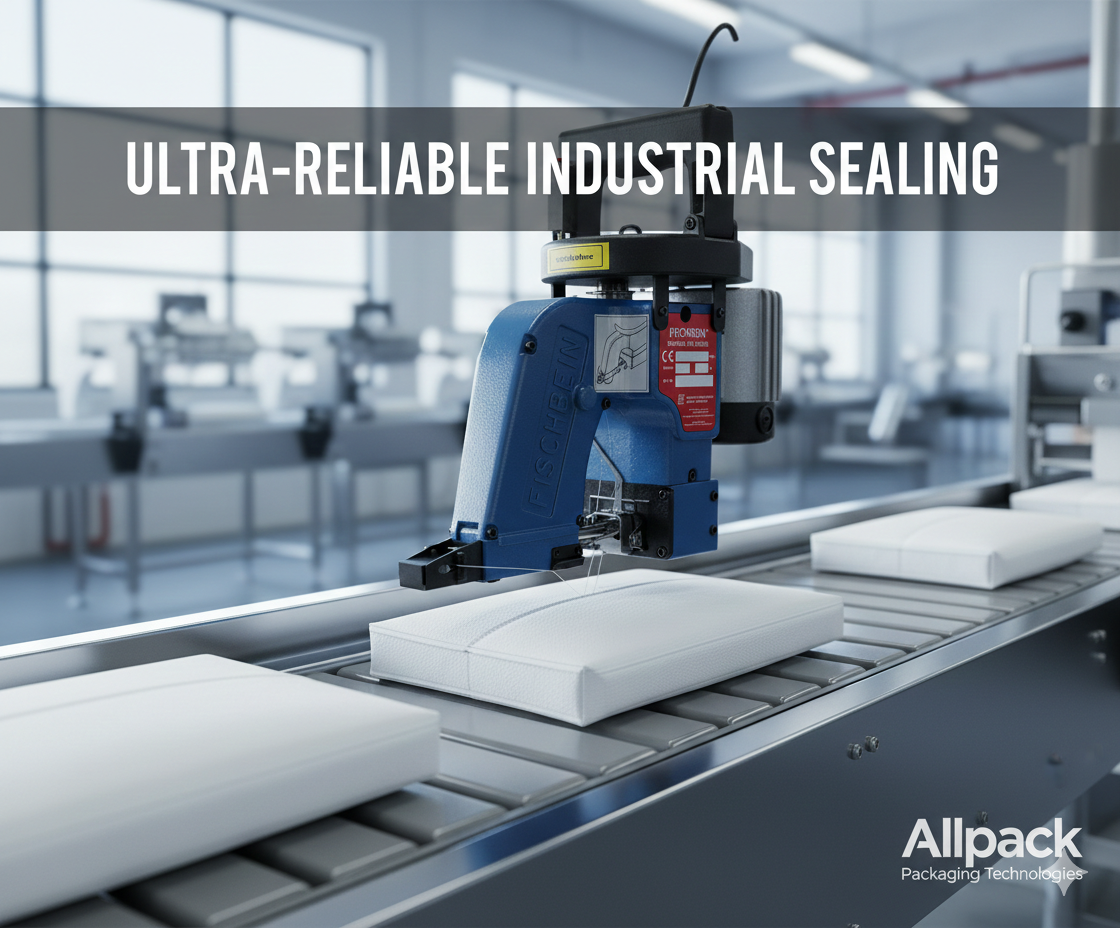
Fischbein Bag Closer: Your Expert Guide to Efficient, Reliable Bag Sealing

January 28, 2026
In modern packaging lines, speed, reliability, and seal integrity are non-negotiable. If your operation uses woven or paper sacks, a Fischbein bag closer could be the critical component that keeps products secure from field to shelf. This guide, from Allpack Packaging Technologies, breaks down how Fischbein bag closers work, the different models available, how to select the right closer for your material and throughput, maintenance tips, and practical optimization strategies to improve line efficiency and reduce downtime.
What is a Fischbein bag closer?
Fischbein bag closers are automated sealing systems designed for industrial bagging operations. They are commonly used in industries such as food, chemicals, agriculture, and construction, where sacks made of polypropylene, jute, or paper must be sealed quickly and securely. Key characteristics include:
- High-speed operation suitable for continuous production lines
- Consistent seal quality across thousands of bags per shift
- Compatibility with a range of bag materials and sizes
- Versatility for different sealing methods (hot-melt, impulse, or heat-seal variants depending on model)
At a high level, a Fischbein bag closer typically integrates with a bagging scale, a sewn or taped seam process, and a downstream conveyor. The goal is to create a reliable, tamper-evident seal while minimizing material waste and energy consumption.
Why choose a Fischbein bag closer?
Investing in a Fischbein bag closer offers several tangible benefits:
- Seal integrity and reliability: A well-tuned closer produces uniform seals that resist moisture, dust, and product leakage.
- Throughput optimization: High-speed closers reduce cycle times, increasing bags-per-minute without sacrificing quality.
- Versatility across materials: Fischbein offers models compatible with a wide range of bag types, including polywoven, paper, and laminated sacks.
- Reduced downtime: Modern closers incorporate easy-to-service components and modular designs for faster maintenance.
- Compliance and traceability: Many Fischbein systems support integration with factory controls and labeling to meet traceability requirements.
For brands like Allpack Packaging Technologies, the emphasis is on selecting a closer that aligns with your exact bag dimensions, product characteristics, and production workflow, ensuring a scalable and future-proof packaging line.
Key Fischbein models and technologies
Fischbein’s product family covers several approaches to bag closing. Below are common categories you’ll encounter, along with what to consider in your evaluation:
- High-speed closing heads: Ideal for large-scale operations, these systems prioritize consistent seals at high throughput. Look for options with modular heads, quick-change components, and minimal warm-up times.
- Impulse heat sealers: These use a short burst of electrical current to seal the bag, often suitable for thermoplastic bags. They can offer fast cycle times and strong seals when properly tuned.
- Hot-air or hot-bar seals: Some Fischbein configurations rely on controlled heat to fuse materials. These are effective for certain bag compositions but require careful temperature control to prevent damage.
- Integrated automation packages: Modern Fischbein closers can be integrated with bag applicators, augers, fillers, and palletizing systems, enabling end-to-end line synchronization.
When choosing a model, assess:
- Bag material compatibility (polypropylene, PE, paper, laminated substrates)
- Bag size range (width and height)
- Desired production speed (bags per minute)
- Seal strength and environmental exposure (dust, humidity, abrasion)
- Maintenance requirements and spare-part availability
- Electrical and control system compatibility with your plant
How a Fischbein bag closer works
While specific mechanisms vary by model, a typical Fischbein bag closer operates through a sequence like this:
- Bag presence detection: A sensor confirms a filled bag is in position on the conveyor.
- Bag alignment: The bag is guided into the sealing head with precise alignment to ensure a consistent seal.
- Seal process: The sealing element (heat bar, impulse element, or hot-air source) engages for a calibrated dwell time to form a secure seal.
- Cooling or set time: Some systems allow a short dwell to ensure the seal sets before removal.
- Discharge: The sealed bag advances to the next station (stacking, weighing, labeling, or palletizing).
Control systems monitor temperature, dwell time, and cycle count, enabling real-time adjustments for consistent performance. Regular calibration and preventive maintenance help maintain seal integrity and reduce the risk of compromised packaging.
Material considerations and compatibility
Choosing the right Fischbein bag closer begins with understanding your bag material and contents. Key considerations include:
- Bag material: Polypropylene woven, high-density polyethylene, paper, or laminated fabrics each respond differently to heat and pressure.
- Seal type compatibility: Some materials require controlled heat for bonding; others rely on impulse sealing for a clean edge.
- Product abrasiveness and puncture risk: If contents are sharp or abrasive, you may need reinforced seal zones or protective liners.
- Environmental exposure: Moisture, heat, or chemical vapors can impact seal longevity and bag integrity.
- Bag dimensions: Ensure your chosen model supports the width and height range of your bags, plus tolerance for occasional size variation.
Allpack Packaging Technologies recommends collaborating with your engineering team to test a representative sample of bags with the closer you intend to purchase. Real-world trials help confirm seal strength, leak resistance, and overall line efficiency.
Maintenance and uptime optimization
To maximize uptime and extend the life of your Fischbein bag closer, follow these best practices:
- Preventive maintenance schedule: Establish a routine for inspecting heating elements, belts, cutters, and sensors. Document wear patterns and replace components before failure.
- Temperature control: Calibrate heat settings based on bag material and product contents. Even small deviations can affect seal integrity.
- Cleaning and hygiene: Regularly clean the sealing area to prevent residue buildup that can impair seals. For food-grade applications, adhere to sanitation guidelines.
- Lubrication and moving parts: Apply manufacturer-recommended lubricants to chains, bearings, and guides to reduce friction and wear.
- Spare parts strategy: Maintain a controlled inventory of critical components (seals, heating elements, thermocouples) to minimize downtime.
- Safety checks: Ensure guards, interlocks, and emergency stops are functional. Operator training should cover safe start-up and shutdown procedures.
- Calibration and validation: Periodically verify seal strength with standardized tests and document results for quality audits.
Throughput optimization and process integration
A higher-performing packaging line is not just a closer but an integrated system. Consider:
- Synchronization with upstream fillers: Align bag filling speed and timing with the closer to reduce bottle-necks.
- Downstream compatibility: Ensure the output of the closer matches the capabilities of conveyors, scales, bag tippers, and palletizers.
- Automation level: Evaluate whether your line benefits from servo-controlled actuators, programmable logic controllers (PLCs), and human-machine interfaces (HMIs) that offer real-time visibility and quick parameter changes.
- Changeover efficiency: For lines that switch between products or bag sizes, modular fixtures and quick-change parts minimize downtime.
- Energy efficiency: Look for energy-saving modes, efficient heating elements, and cooling strategies that reduce overall consumption per bag sealed.
Sizing and procurement considerations
When budgeting for or upgrading a Fischbein bag closer, consider:
- Throughput requirement: Specify target bags per minute (BPM) and peak demand with growth projections.
- Bag range and compatibility: Confirm maximum/minimum bag width and height, thickness, and material compatibility.
- Integration needs: Decide whether you need standalone operation or full-line integration with existing equipment.
- Footprint and installation: Measure floor space, line layout, and any required structural support or electrical infrastructure.
- Service and support: Verify the availability of local service technicians, remote diagnostics, and spare parts from the manufacturer or distributor.
- Total cost of ownership: Weigh initial purchase price against maintenance, energy use, downtime risk, and productivity gains.
Real-world use cases and industry applications
- Food products: Flour, sugar, coffee, and snack ingredients often require moisture-resistant seals and clean operation to avoid contamination.
- Agricultural commodities: Grains and seeds benefit from tight seals to preserve freshness and prevent pest ingress.
- Chemicals and minerals: Sealing performance and containment are critical for safety and regulatory compliance.
- Building materials: Cement, plaster, and sand bags demand robust seals to protect contents during handling and transport.
In each case, a Fischbein bag closer contributes to overall packaging reliability, reducing product loss and returns while supporting compliance with industry standards.
Expert tips from Allpack Packaging Technologies
- Start with a bag sample study: Before deciding on a closer, test your actual bag material with a sample run to assess seal integrity and bag performance under expected storage and transport conditions.
- Prioritize maintenance as a competitive advantage: A well-maintained machine reduces unplanned downtime more effectively than a marginally faster but unreliable system.
- Plan for scalability: Choose a model that accommodates not only current bag sizes but future product expansions or line expansions.
- Leverage data: Use temperature and cycle data collected by the closer to continuously optimize settings and predict maintenance needs.
- Work with a trusted partner: Partner with Allpack Packaging Technologies for equipment evaluation, installation, and ongoing optimization to ensure you get the most from your investment.
FAQ: Fischbein bag closer
What is a Fischbein bag closer?
A Fischbein bag closer is an automated sealing system designed for industrial bagging lines, providing fast, reliable seals on various bag materials.
What materials can Fischbein bag closers seal?
They are compatible with common bag substrates such as polypropylene woven, PE, paper, and laminated films, with models optimized for specific materials.
How do I know which Fischbein model is right for my line?
Consider bag material, bag size range, required throughput (BPM), seal type, environmental conditions, and integration needs with your production line. A vendor assessment or trial run is recommended.
What maintenance does a Fischbein bag closer require?
Regular inspection of heating elements, sensors, seals, and moving parts; cleaning to prevent residue; and timely replacement of wear components. A preventive maintenance plan is essential.
How can I improve line efficiency with a Fischbein closer?
Achieve efficiency through proper model selection, precise calibration, line synchronization with upstream/downstream equipment, quick-change components for fast changeovers, and ongoing data-driven optimization.




