
ISI Mark Registration in India | BIS ISI Certification by Compliance Calendar LLP

July 20, 2026
The ISI Mark is one of the most trusted quality marks in India. It shows that a product conforms to the relevant Indian Standard prescribed by the Bureau of Indian Standards, commonly known as BIS. For many products, obtaining BIS ISI Mark Certification is not only a quality requirement but also a legal necessity before manufacturing, selling, distributing or importing such products in India.
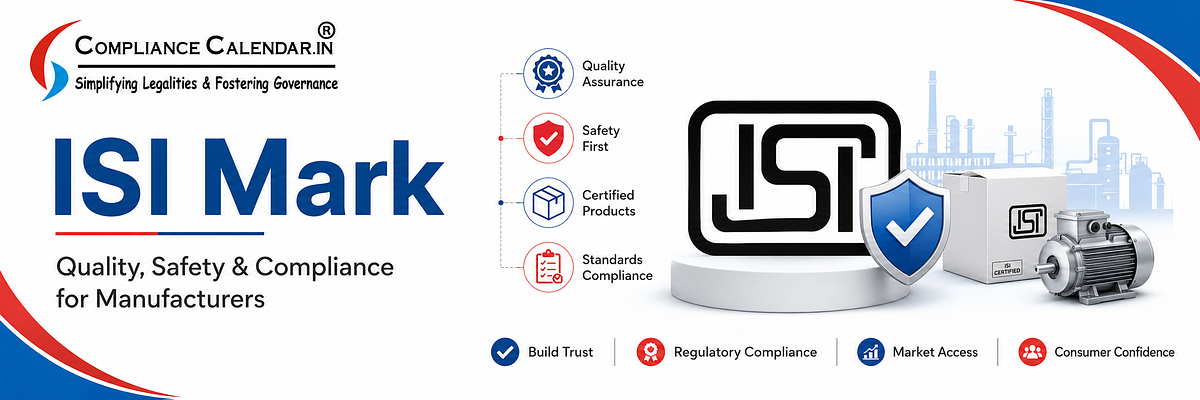
The ISI Marking Scheme was originally launched in 1955 and continues to be widely recognized by consumers, businesses and government authorities as a symbol of safety, reliability and quality. BIS grants permission to use the Standard Mark on a product only after assessing the manufacturer’s production capability, testing facilities and product conformity with the applicable Indian Standard.
What is ISI Mark?
The ISI Mark is a certification mark used on products that comply with the relevant Indian Standards. It is issued under the product certification scheme of BIS. When a product carries the ISI Mark along with the licence number, it gives confidence to consumers that the product has been tested and approved as per prescribed quality and safety standards.
The licence number is also required to be shown along with the BIS Standard Mark, generally below the mark in the format “CM/L-XXXXXXXXXX”.
Common products where ISI Mark certification may be required include electrical appliances, cement, steel products, pressure cookers, helmets, toys, packaged drinking water, household products, building materials and various industrial goods, depending on the applicable Indian Standard and Quality Control Order.
Why ISI Mark Registration is Important
ISI Mark Registration is important because it ensures that products meet required safety, quality and performance standards. In India, consumers often prefer ISI-marked products because the mark creates trust and indicates that the product has passed prescribed quality checks.
For manufacturers, ISI Mark certification improves product credibility and helps in market acceptance. For products covered under mandatory certification, it is legally required before sale or distribution. Selling products without a valid BIS licence, where certification is compulsory, may result in regulatory action, penalties and business restrictions.
Benefits of ISI Mark Registration
1. Builds Consumer Trust
The ISI Mark is widely recognized by Indian consumers. It assures buyers that the product has been manufactured and tested as per Indian Standards. This increases trust and helps businesses build a stronger brand reputation.
2. Legal Compliance
For products covered under compulsory BIS certification, ISI Mark Registration is mandatory. A valid BIS licence helps the manufacturer comply with applicable Quality Control Orders and avoid legal complications.
3. Better Market Acceptance
Distributors, retailers, government buyers and institutional purchasers often prefer certified products. ISI Mark certification can improve marketability and make the product more acceptable in competitive markets.
4. Product Quality Improvement
The BIS certification process requires manufacturers to maintain proper quality control systems, testing arrangements and production consistency. This helps improve product quality and reduce defects.
5. Competitive Advantage
An ISI-marked product can stand out in the market because it carries an official quality mark. This gives manufacturers a competitive edge over non-certified products.
6. Support in Government Tenders
Many government departments and public sector buyers require BIS-certified products for procurement. ISI Mark Registration may help manufacturers participate in such opportunities.
7. Reduces Consumer Complaints
Since certified products are tested against specific standards, the chances of poor quality, safety issues and consumer complaints may reduce significantly.
ISI Mark Registration Process in India
Step 1: Product Applicability Check
The first step is to check whether the product falls under BIS certification and which Indian Standard applies. Some products require mandatory certification, while others may be covered under voluntary certification.
Step 2: Documentation Preparation
The manufacturer must prepare all required documents, including business registration proof, factory details, manufacturing process details, test facility information and product specifications.
Step 3: Application Filing
The application for BIS ISI Mark Certification is filed with the required details and documents. The applicant must ensure that all information is accurate and matches the product and factory records.
Step 4: Factory Inspection
BIS officials may inspect the manufacturing unit to verify production facilities, testing arrangements, quality control system, raw material records and manufacturing process.
Step 5: Product Testing
Product samples are tested as per the applicable Indian Standard. Testing may be conducted in BIS-recognized laboratories or as per the procedure prescribed by BIS.
Step 6: Review and Clarification
If BIS raises any query or observation, the manufacturer must submit a proper reply with supporting documents. Any gap in testing, documentation or factory compliance should be corrected quickly.
Step 7: Grant of BIS Licence
After successful review, testing and inspection, BIS grants the licence to use the ISI Mark on the approved product. The manufacturer can use the mark only as per the licence terms and marking guidelines.
Step 8: Post-Certification Compliance
After getting the licence, the manufacturer must maintain product quality, follow testing requirements, keep proper records, comply with surveillance inspections and renew the licence on time.
Documents Required for ISI Mark Registration
The exact documents may vary depending on the product, applicant type and BIS requirements. However, the commonly required documents for BIS ISI Mark Registration include:
- Certificate of Incorporation, Partnership Deed or business registration proof
- PAN card of the business entity
- GST Registration Certificate
- Factory address proof
- Manufacturing unit layout plan
- List of machinery and manufacturing equipment
- Details of manufacturing process
- Product technical specifications
- Details of raw materials used
- In-house testing facility details
- Calibration certificates of testing equipment
- Test reports, if applicable
- Quality control documents
- Authorization letter or board resolution
- ID and address proof of authorized signatory
- Trademark registration certificate or brand authorization, if applicable
- Undertaking and declaration as required by BIS
- Product samples for testing
Proper documentation is a key part of the ISI Mark certification process. Any mismatch in product details, factory address, brand name, applicant name or testing information may lead to delay or objection.
Why Choose Compliance Calendar LLP for ISI Mark Registration?
Compliance Calendar LLP helps manufacturers, importers and businesses complete their BIS certification journey with professional guidance and end-to-end support. Our team assists in product applicability checks, document preparation, application filing, lab coordination, factory inspection support, query handling and post-certification compliance.
With practical experience in regulatory and product certification matters, Compliance Calendar LLP ensures that your ISI Mark Registration process is handled in a structured and timely manner. Whether you are a new manufacturer planning to launch your product or an existing business looking to regularize compliance, our experts can guide you through every stage of BIS ISI Certification.

You Might Like Also


Who Needs SEBI Research Analyst Registration in India?

Who Needs SEBI Research Analyst Registration in India?






