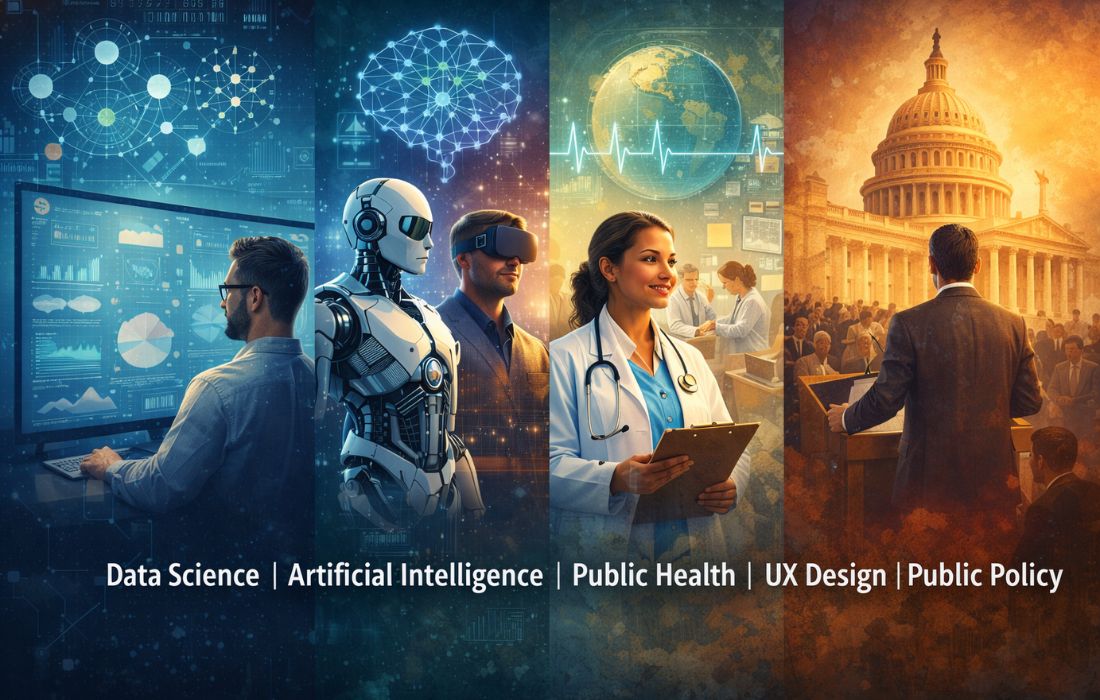
Master’s Programs Driving Careers in Technology, Health, Design, and Policy

January 03, 2026
The demand for specialized education has never been higher. Today’s students are looking for master’s programs that equip them with practical skills, global perspectives, and the ability to solve complex challenges. Among the most impactful postgraduate programs are MSc in Data Science, MSc Artificial Intelligence, Master of Public Health, Master of User Experience Design, and MA in Public Policy. These degrees prepare students to thrive in rapidly evolving industries while addressing societal needs.
This article explores these five programs, examining their curriculum, career prospects, and global relevance.
The Rise of Specialized Master’s Degrees
Modern industries are increasingly interconnected and data driven. Employers value professionals who combine domain expertise with analytical thinking and creativity. This has led to the growth of specialized master’s programs. Students now pursue degrees not only for career advancement but also for their ability to contribute to meaningful outcomes in technology, healthcare, design, and governance.
MSc in Data Science and MSc Artificial Intelligence focus on technical innovation and advanced analytics. Master of Public Health and MA in Public Policy emphasize societal impact, research, and leadership. Master of User Experience Design bridges technology and human interaction, ensuring that digital products are effective and user friendly.
MSc in Data Science: Unlocking Insights from Data
Data is the backbone of modern decision making. MSc in Data Science equips students with the knowledge and skills to analyze, interpret, and leverage large datasets. Organizations across finance, healthcare, e-commerce, and government rely on data professionals to improve operations and predict future trends.
Curriculum Highlights
Students in MSc in Data Science programs study statistical modeling, machine learning, database management, and data visualization. Programming languages such as Python and R are central to the coursework. Advanced topics often include big data technologies, predictive analytics, cloud computing, and ethical data management.
Practical experience is emphasized through internships, capstone projects, and collaborative assignments. These opportunities allow students to apply theoretical concepts to real world problems.
Career Opportunities
Graduates of MSc in Data Science can work as data analysts, data scientists, business intelligence specialists, and machine learning engineers. With experience, they may advance to roles in data strategy, analytics leadership, or AI integration across organizations.
MSc Artificial Intelligence: Shaping the Future of Technology
Artificial intelligence is no longer a futuristic concept. It is now an integral part of daily life, from virtual assistants to autonomous vehicles. MSc Artificial Intelligence trains students to create intelligent systems capable of learning, adapting, and solving complex problems.
Academic Focus
The program covers machine learning, neural networks, computer vision, natural language processing, and robotics. Students learn to design algorithms that process large datasets and generate actionable insights. Ethical considerations, such as responsible AI development and bias mitigation, are key components of modern AI programs.
Hands on projects and research assignments help students build practical expertise. Many programs encourage collaboration with industry partners or research institutions to ensure exposure to real world AI applications.
Career Pathways
Graduates can pursue careers as AI engineers, machine learning engineers, research scientists, or AI consultants. Industries like healthcare, finance, technology, and cybersecurity increasingly rely on AI specialists to optimize processes, enhance products, and improve decision making.
Master of Public Health: Advancing Population Wellbeing
Public health professionals play a critical role in promoting health and preventing disease on a population scale. The Master of Public Health focuses on preparing leaders who can design, implement, and evaluate public health initiatives.
Curriculum Overview
Master of Public Health programs cover epidemiology, biostatistics, health policy, environmental health, and health promotion. Students gain the skills needed to analyze community health needs, assess interventions, and create programs that address social determinants of health.
Fieldwork, internships, and community based research are central to most programs. These practical experiences allow students to translate knowledge into actionable solutions in real world settings.
Career Opportunities
Graduates can work in public health agencies, hospitals, non governmental organizations, research institutions, and international organizations. Roles include epidemiologist, public health analyst, health program manager, and policy advisor.
The degree is particularly suited for students interested in social impact, global health, and healthcare leadership.
Master of User Experience Design: Designing Digital Experiences
Digital technology has transformed how people interact with services, products, and information. Master of User Experience Design prepares students to create intuitive and meaningful user experiences.
Academic Focus
The program emphasizes design thinking, user research, interaction design, information architecture, and usability testing. Students learn how to understand user behavior and create products that meet user needs effectively.
Hands on projects, prototyping exercises, and portfolio development are essential components of the curriculum. Students often collaborate with real clients or tech companies to design and test solutions.
Career Paths
Graduates can pursue careers as UX designers, UX researchers, interaction designers, and product designers. These roles are in demand across technology companies, startups, consultancy firms, and public sector organizations.
The degree suits students from diverse backgrounds, including design, psychology, computer science, and communications.
MA in Public Policy: Driving Evidence Based Governance
MA in Public Policy prepares professionals to understand, analyze, and influence policymaking processes. Governments and organizations increasingly rely on evidence based approaches to address complex societal challenges.
Curriculum Overview
The program covers policy analysis, public administration, political science, economics, and research methodology. Students learn how to assess policy alternatives, evaluate outcomes, and develop recommendations for effective governance.
Case studies, research projects, and policy briefs are often part of the coursework. These activities build analytical, communication, and leadership skills essential for public policy roles.
Career Opportunities
Graduates can work as policy analysts, public affairs consultants, legislative assistants, and program evaluators. Opportunities exist in government agencies, think tanks, international organizations, and advocacy groups.
The degree is ideal for students committed to governance, social justice, and sustainable development.
Comparing the Five Programs
MSc in Data Science and MSc Artificial Intelligence equip students with technical expertise to drive innovation in data and technology. Master of Public Health and MA in Public Policy focus on societal impact, equipping graduates to create policies and interventions that improve public welfare. Master of User Experience Design bridges human behavior and technology to create accessible and engaging digital experiences.
Each program offers a unique perspective but shares a common goal: preparing graduates to address modern challenges with knowledge, creativity, and ethical responsibility.
Choosing the Right Master’s Degree
When selecting a program, students should consider their interests, academic background, and career objectives. Those interested in analytics, programming, and AI may lean toward MSc in Data Science or MSc Artificial Intelligence. Students passionate about healthcare, community wellbeing, or social impact may find the Master of Public Health most suitable. Creative thinkers who enjoy problem solving through design may prefer the Master of User Experience Design. Students motivated to influence governance and policymaking may find the MA in Public Policy the most rewarding.
Each degree offers global opportunities and transferable skills that make graduates valuable across industries and regions.
The Global Impact of These Degrees
All five programs are highly relevant in a global context. Graduates are equipped to work in international organizations, multinational companies, government agencies, and global non profits. Online and hybrid program formats further expand access, allowing students from different countries to pursue these degrees from reputable institutions.
By combining specialized knowledge with practical skills, graduates are prepared to contribute to innovation, social welfare, and effective governance.
Conclusion
MSc in Data Science, MSc Artificial Intelligence, Master of Public Health, Master of User Experience Design, and MA in Public Policy represent the forefront of modern master’s education. They prepare students to respond to global challenges, create impactful solutions, and lead in their chosen fields.
Students who pursue these programs gain not only technical or analytical expertise but also critical thinking, ethical awareness, and leadership skills. In a world defined by rapid technological change and complex societal needs, these master’s degrees offer a path to meaningful and rewarding careers.

You Might Like Also






