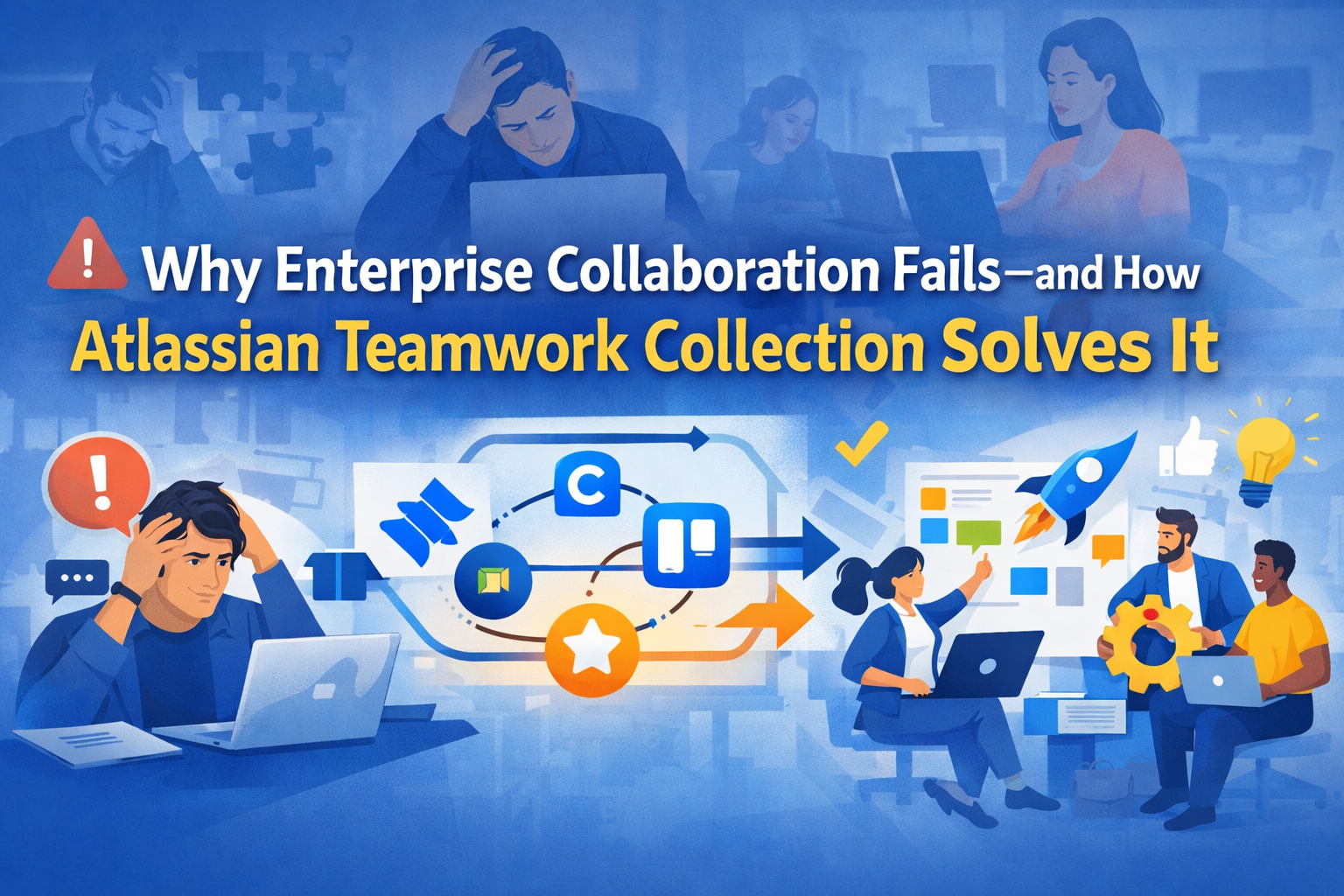
Why Enterprise Collaboration Fails—and How Atlassian Teamwork Collection Solves It

January 30, 2026
Enterprise collaboration often fails not because of a lack of tools, but due to fragmented systems, unclear ownership, and poor information flow across teams. As organizations scale, disconnected work management platforms create silos that slow delivery and reduce accountability. Teams struggle to align goals, share context, and make informed decisions in real time. Modern enterprises require an integrated approach that connects people, work, and knowledge across functions. The Atlassian teamwork collection addresses these challenges by unifying collaboration, project execution, and knowledge management into a single, connected ecosystem designed for complex, cross-functional enterprise environments.
Fragmented Tools Create Silos Across Enterprise Teams
Enterprise collaboration frequently breaks down when teams rely on disconnected tools that fail to share context or data. Different departments often select tools independently, resulting in overlapping functionality and inconsistent workflows. This fragmentation limits visibility, slows coordination, and increases operational overhead across the organization.
- Disconnected project and knowledge systems
When project tracking and documentation live in separate platforms, teams lose critical context. This separation forces manual updates and increases the risk of outdated or incomplete information. - Inconsistent workflows across departments
Each team configures tools differently, leading to mismatched processes. These inconsistencies make cross-team collaboration difficult and reduce predictability in delivery. - Limited cross-tool visibility for leaders
Leadership lacks a unified view of work progress and dependencies. Decision-making becomes reactive instead of data-driven. - Increased context switching for employees
Users constantly move between applications to complete basic tasks. This disrupts focus and lowers overall productivity. - Higher administrative and maintenance costs
Managing multiple tools increases licensing, integration, and support overhead. IT teams spend more time maintaining systems than enabling outcomes.
Lack of Shared Context Slows Decision Making
Collaboration fails when teams cannot easily access shared context around work, decisions, and priorities. Information scattered across tools and formats makes it difficult to understand why decisions were made or how work connects to broader objectives. This slows execution and introduces unnecessary risk.
- Decisions documented outside execution systems
Key decisions often live in emails or chat messages. Teams lose traceability between decisions and actual work items. - Poor visibility into work dependencies
Teams cannot easily see how their work impacts others. This results in missed handoffs and delivery delays. - Delayed access to critical knowledge
Employees struggle to find relevant documentation when needed. Time is wasted searching instead of executing. - Misalignment between strategy and delivery
High-level goals are not clearly linked to day-to-day work. Teams may deliver outputs that do not support strategic priorities. - Increased reliance on meetings for clarity
Lack of shared context drives excessive meetings. Collaboration becomes synchronous and inefficient instead of scalable.
Unclear Ownership Leads to Accountability Gaps
Enterprise teams often fail to collaborate effectively when ownership is unclear. Without well-defined responsibility across initiatives, work stalls, issues escalate slowly, and accountability becomes diffused across teams. Clear ownership is essential for predictable delivery.
- Ambiguous responsibility for cross-team work
Multiple teams contribute to shared outcomes without clear owners. Issues fall through the cracks during handoffs. - Delayed issue resolution and escalation
Problems are identified late because no single team owns resolution. This increases risk and operational impact. - Lack of visibility into who owns what
Teams cannot easily identify accountable individuals. Collaboration slows as people search for the right contacts. - Difficulty tracking progress across initiatives
Work ownership is not consistently reflected in tools. Leaders lack confidence in reported status. - Reduced trust between teams
Unclear accountability creates friction and blame. Collaboration becomes defensive rather than outcome-focused.
Manual Processes Reduce Team Productivity at Scale
As organizations grow, manual collaboration processes become a significant bottleneck. Tasks such as updates, reporting, and coordination consume time that should be spent on value-adding work. Automation and structured workflows are critical for enterprise efficiency.
- Manual status updates across multiple tools
Teams spend time duplicating updates in different systems. This increases errors and reduces data reliability. - Inefficient handoffs between teams
Work transitions require manual coordination. Delays occur when dependencies are not automatically tracked. - Limited automation of routine tasks
Repetitive actions are performed manually. This reduces consistency and scalability. - Inaccurate reporting due to human error
Manual data entry leads to incomplete or outdated reports. Leadership lacks confidence in metrics. - Reduced capacity for strategic work
Teams focus on process management instead of outcomes. Productivity gains remain unrealized.
Poor Visibility Impacts Leadership and Governance
Leadership effectiveness depends on accurate, real-time visibility into work across the enterprise. When collaboration tools do not provide unified insights, governance becomes reactive and risk increases. Visibility is essential for alignment and control.
- No single source of truth for work data
Information is spread across tools and teams. Leaders struggle to understand overall progress. - Limited insight into risks and blockers
Issues surface late due to poor reporting. Proactive intervention becomes difficult. - Difficulty measuring team performance
Metrics are inconsistent across departments. Benchmarking and optimization are unreliable. - Challenges enforcing governance standards
Processes vary widely across teams. Compliance becomes harder to maintain. - Reduced confidence in delivery forecasts
Leadership cannot accurately predict outcomes. Planning becomes less effective.
Disconnected Knowledge Weakens Enterprise Learning
Enterprise collaboration depends heavily on accessible, well-structured knowledge. When documentation is fragmented or outdated, teams repeat mistakes and lose institutional knowledge. Strong knowledge management supports long-term performance.
- Knowledge stored in isolated repositories
Documentation is not linked to active work. Teams struggle to apply lessons learned. - Outdated or duplicated information
Multiple versions of documents exist. Trust in knowledge assets declines. - Low discoverability of critical content
Search capabilities are limited across tools. Employees waste time finding information. - Onboarding new employees becomes difficult
New hires lack access to contextual knowledge. Ramp-up times increase. - Loss of expertise during employee turnover
Key insights leave with individuals. Organizational learning stagnates.
Integrated Platforms Enable Scalable Enterprise Collaboration
Solving enterprise collaboration challenges requires an integrated platform approach. Connecting work, knowledge, and communication enables teams to operate with shared context, clear ownership, and consistent visibility. This foundation supports scalable collaboration.
- Unified work and knowledge ecosystem
Projects, documentation, and communication are connected. Teams collaborate with full context. - Standardized workflows across teams
Processes scale consistently across the organization. Collaboration becomes predictable and efficient. - Built-in automation and intelligence
Routine tasks are automated to reduce overhead. Teams focus on outcomes instead of administration. - Enterprise-grade visibility and reporting
Leaders gain real-time insights across initiatives. Governance and planning improve. - Improved alignment between strategy and execution
Work directly supports business goals. Collaboration drives measurable outcomes.
Conclusion
Enterprise collaboration fails when tools, teams, and knowledge operate in isolation, creating friction that limits scale and execution. Fragmentation, unclear ownership, manual processes, and poor visibility all contribute to misalignment and reduced productivity. Addressing these challenges requires a connected approach that unifies work management, knowledge sharing, and collaboration across the organization. The Atlassian TWC provides a structured foundation that enables shared context, consistent workflows, and enterprise-wide visibility. By aligning people and work within an integrated ecosystem, organizations can improve accountability, accelerate decision-making, and support sustainable collaboration as business complexity continues to grow.

You Might Like Also




