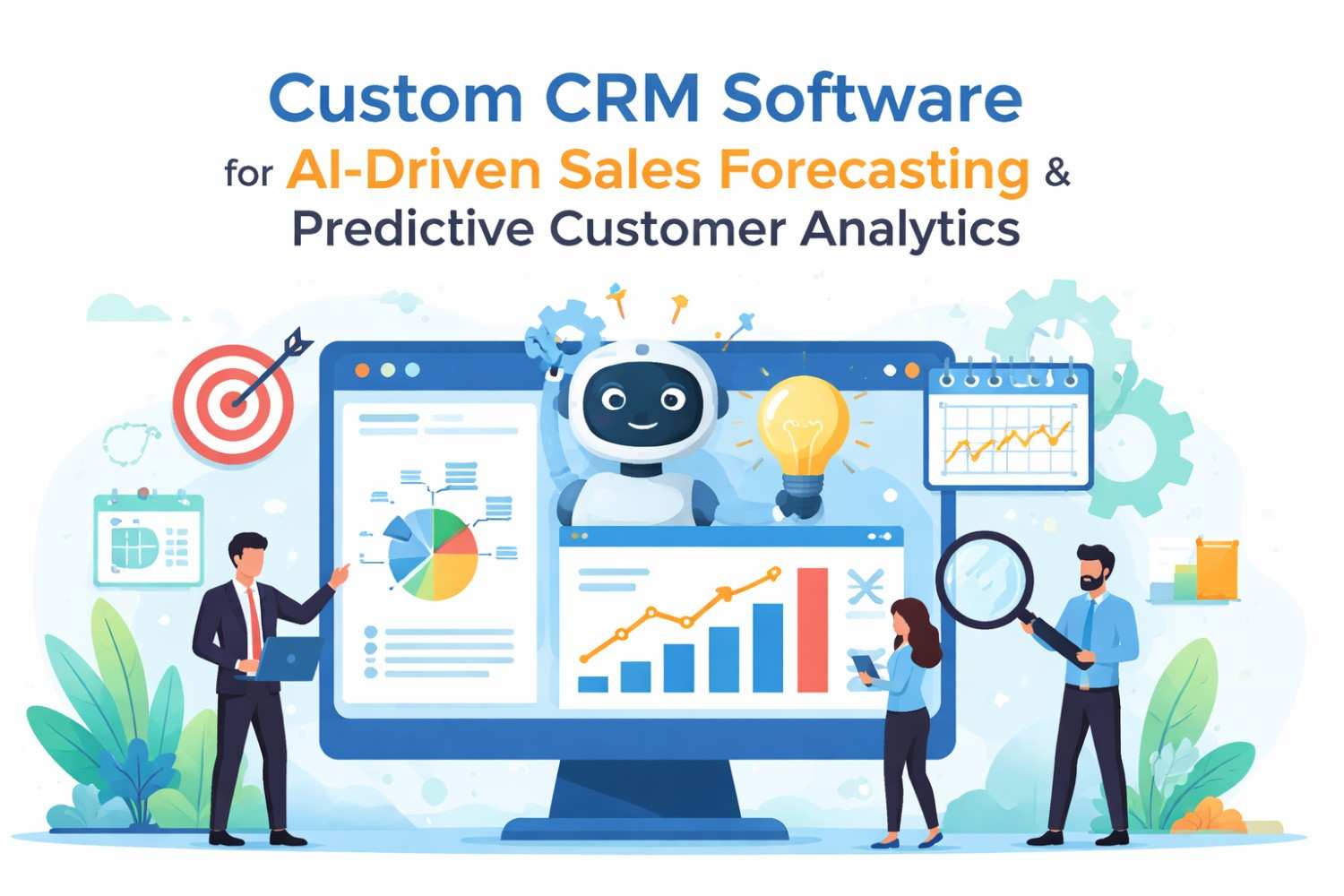
Introduction: Why Guessing Sales Never Worked Anyway
I once trusted a sales forecast built on optimism, caffeine, and a color-coded spreadsheet. It looked impressive. It was also wildly wrong. Lesson learned. Sales forecasting has always lived somewhere between educated guesswork and wishful thinking, which is fine until revenue depends on it. This is where custom CRM software powered by AI quietly changes the rules. Instead of relying on gut feelings and last quarter’s numbers, businesses can finally lean on patterns, probabilities, and predictive insight. And yes, this is where things start getting interesting.
What Is Custom CRM Software (And Why “Custom” Actually Matters)
Custom CRM software isn’t about fancy dashboards—it’s about relevance. Unlike off-the-shelf CRMs that force businesses into predefined workflows, a custom-built CRM adapts to how your sales team actually works (quirks and all). This flexibility matters even more when AI enters the picture. AI models need clean, structured, meaningful data—and generic systems rarely deliver that. Working with the right crm development ensures the CRM is designed around your data, your customers, and your long-term growth goals. Which, conveniently, sets the stage for smarter forecasting.
AI-Driven Sales Forecasting: From Gut Feelings to Data Truth
Traditional forecasting looks backward; AI-driven forecasting looks forward. By analyzing historical sales data, customer behavior, seasonality, and market signals, AI can predict outcomes with far greater accuracy. It doesn’t get tired. It doesn’t get overly optimistic after one good month. And it definitely doesn’t “feel” like a deal will close—it calculates it. This shift replaces emotional forecasting with probability-based insight. Naturally, once sales leaders see forecasts aligning with reality (what a concept), trust in data-driven decision-making grows fast.
Predictive Customer Analytics: Knowing Customers Before They Know Themselves
Predictive customer analytics sounds slightly creepy until it starts working remarkably well. Using AI, CRM systems can anticipate churn, identify upsell opportunities, and predict lifetime value based on behavior patterns. It’s less about mind-reading and more about recognizing signals humans miss. Customers rarely announce their intentions clearly—data does. This approach helps sales and marketing teams act proactively instead of reactively. And yes, it’s oddly satisfying when the system flags a “high-risk” account you had a bad feeling about anyway.
How Custom CRM and AI Actually Work Together
AI is only as good as the system feeding it. That’s where custom CRM design becomes critical. A tailored CRM structures data in a way machine learning models can actually use—clean inputs, consistent fields, and meaningful relationships. When AI is embedded directly into CRM workflows, insights appear where decisions happen, not buried in reports no one opens. A capable crm development company ensures AI features are integrated intentionally, not bolted on as an afterthought. The result is intelligence that feels practical, not theoretical.
Real-World Business Benefits (The “So What?” Section)
Here’s the practical payoff. AI-driven CRM improves forecast accuracy, shortens sales cycles, and highlights opportunities sales teams would otherwise miss. It reduces human bias (we all have favorites), improves pipeline visibility, and helps leadership plan with confidence instead of crossed fingers. One recurring theme here: clarity. When teams trust their data, they move faster and argue less. Which, in most organizations, might be the biggest productivity gain of all. Data doesn’t replace humans—it just makes us harder to fool.
Industry Use Cases Worth Noticing
AI-powered CRM systems aren’t industry-specific—they’re problem-specific. In SaaS, they predict churn before customers disappear. In e-commerce, they identify high-value buyers early. Real estate teams forecast deal closures more accurately. Healthcare organizations improve patient engagement. B2B sales teams finally understand long buying cycles. The common thread? Better timing and smarter prioritization. Once businesses see predictive analytics working in one department, expansion becomes inevitable. (Success has a way of spreading.)
Choosing the Right Custom CRM Partner
Not all development partners understand AI—and fewer understand your business. Choosing the right crm development company means looking beyond technical skills. You need experience with data modeling, AI integration, scalability, and security. Ask how they handle training data, system flexibility, and future upgrades. Avoid partners who promise instant results or “plug-and-play AI.” Real intelligence takes planning. The right partner won’t oversell—they’ll explain, challenge assumptions, and design for long-term value rather than short-term flash.
The Future of AI-Driven CRM (A Look Ahead)
Sales forecasting won’t stop at prediction—it’s moving toward prescription. Future CRM systems won’t just say what will happen; they’ll recommend what to do next. Expect more automation, smarter recommendations, and stronger ethical controls around data usage. AI will become quieter, more embedded, and more trusted. The novelty will fade—and usefulness will remain. That’s usually how technology wins. Slowly, then all at once.
Conclusion: Forecasting Without the Fantasy
Sales will always involve uncertainty—but guessing doesn’t have to be part of the process. Custom CRM software infused with AI replaces hopeful projections with informed decisions and reactive selling with strategic action. The real win isn’t just better forecasts; it’s confidence. When data supports decisions, teams move with purpose instead of panic. And after years of trusting spreadsheets that promised too much, that shift feels less like innovation—and more like relief.
FAQs
What is AI-driven sales forecasting in CRM?
It uses machine learning to analyze historical and real-time data to predict future sales outcomes more accurately than manual methods.
How does predictive customer analytics help sales teams?
It identifies churn risks, upsell opportunities, and high-value prospects before human teams notice them.
Is custom CRM better than ready-made CRM software?
Yes, especially for AI use cases, because it aligns data structure with business needs.
How long does it take to build a custom AI CRM?
Typically 3–6 months, depending on complexity and integrations.
Is AI-powered CRM suitable for small businesses?
Absolutely—when scaled appropriately, it improves focus and efficiency.