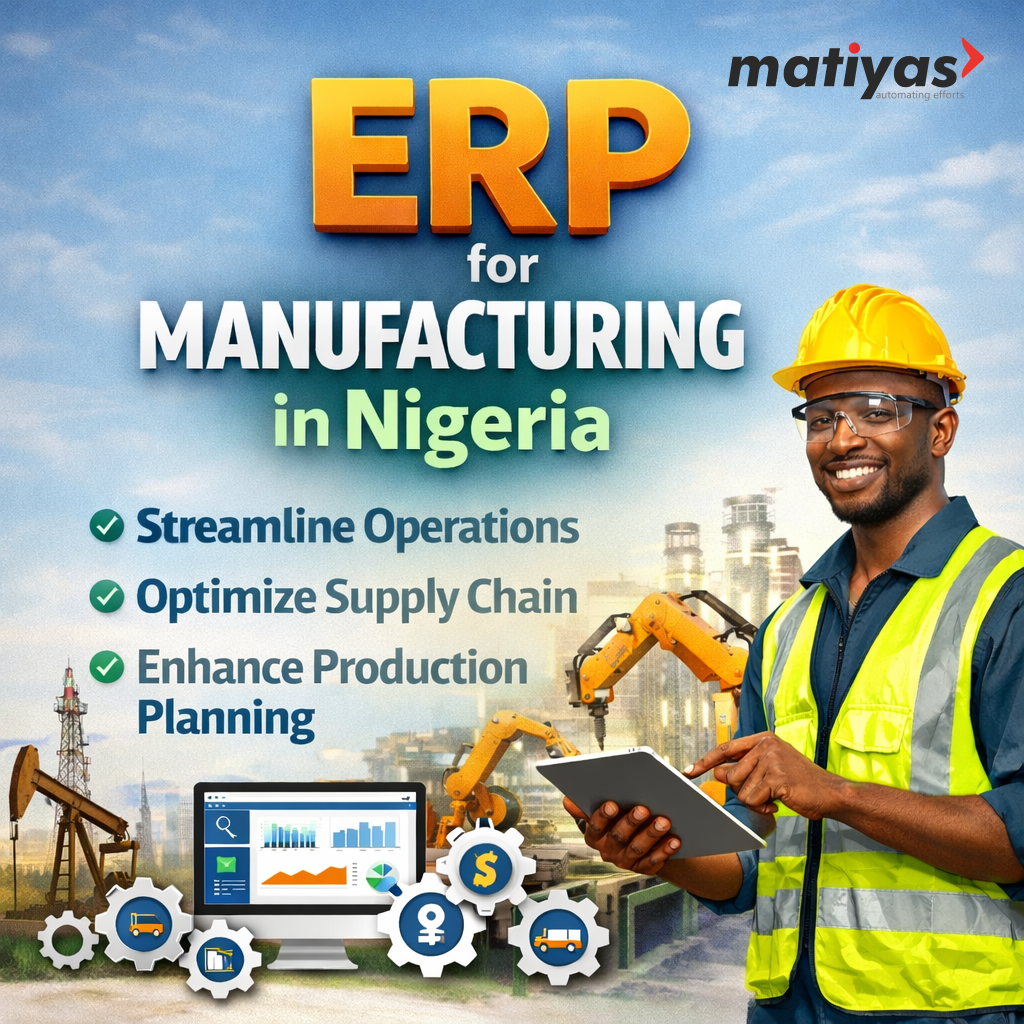
ERP for Manufacturing in Nigeria: Transforming Industrial Growth with Matiyas Solutions

January 29, 2026
The manufacturing industry is a vital pillar of Nigeria’s economy, playing a significant role in job creation, industrial expansion, and national economic development. As market competition intensifies and operational complexities increase, manufacturers must embrace innovative digital technologies to enhance efficiency, reduce operational costs, and scale business performance. One of the most powerful technologies driving this transformation is ERP for Manufacturing.
ERP for Manufacturing (Enterprise Resource Planning) is a comprehensive software solution designed to integrate, automate, and optimize essential manufacturing processes such as production planning, inventory management, procurement, finance, quality control, and supply chain operations. By centralizing data and streamlining workflows, ERP systems enable manufacturers to improve productivity, enhance decision-making, and maintain competitiveness in an evolving global market.
In Nigeria, where manufacturers face challenges such as fluctuating raw material prices, supply chain disruptions, inefficient production processes, and limited operational visibility, adopting a Manufacturing ERP system has become more than a technological upgrade—it is a strategic business necessity.
The Growing Need for ERP for Manufacturing in Nigeria
Nigeria’s manufacturing sector continues to expand across multiple industries, including food processing, textiles, pharmaceuticals, chemicals, construction materials, and consumer goods. Despite this growth, many manufacturers still rely on manual processes, fragmented software tools, and outdated management practices. These inefficiencies often result in production delays, inventory inaccuracies, rising operational costs, and limited business scalability.
ERP for Manufacturing addresses these challenges by providing an integrated digital platform that connects every department within a manufacturing organization. From production scheduling and inventory tracking to financial management and customer order processing, ERP ensures seamless coordination across all business functions.
By implementing ERP, Nigerian manufacturers can:
1. Gain real-time visibility into production and operations
2. Optimize production schedules and resource utilization
3. Reduce waste and lower operational costs
4. Improve product quality and regulatory compliance
5. Strengthen supply chain efficiency
6. Enhance customer satisfaction and retention
As Nigeria advances toward Industry 4.0 and digital transformation, ERP plays a crucial role in modernizing manufacturing operations and improving global competitiveness.
What is ERP for Manufacturing?
ERP for Manufacturing is a specialized ERP system built specifically for manufacturing businesses. Unlike generic ERP platforms, Manufacturing ERP focuses on production workflows, material planning, machine utilization, quality assurance, and process optimization.
A typical Manufacturing ERP system includes modules such as:
1. Production Planning and Scheduling
2. Material Requirements Planning (MRP)
3. Inventory and Warehouse Management
4. Procurement and Supplier Management
5. Quality Control and Compliance
6. Finance and Accounting
7. Human Resource Management
8. Sales and Customer Relationship Management (CRM)
9. Reporting and Business Intelligence
By integrating these modules into a single centralized system, ERP eliminates data silos, minimizes manual errors, improves collaboration, and enhances overall operational efficiency.
Key Challenges Faced by Manufacturers in Nigeria
Despite sector growth, Nigerian manufacturers encounter several persistent operational challenges:
1. Inefficient Production Planning
Manual forecasting and scheduling lead to production delays and bottlenecks.
2. Poor Inventory Management
Lack of real-time tracking results in stock shortages or excess inventory.
3. Rising Operational Costs
Energy expenses, logistics costs, and inefficient resource use increase production expenses.
4. Supply Chain Disruptions
Delays in raw material procurement affect production timelines and customer deliveries.
5. Limited Data Visibility
Without centralized reporting, performance analysis and strategic planning become difficult.
6. Quality Control Issues
Inconsistent product quality can damage brand reputation and customer trust.
ERP for Manufacturing provides a structured and scalable solution to overcome these challenges by improving transparency, efficiency, and control across the production lifecycle.
How ERP for Manufacturing Improves Business Performance
Implementing ERP delivers significant operational and strategic advantages, including:
Streamlined Production Planning
Improves scheduling accuracy, optimizes resource allocation, and minimizes downtime.
Real-Time Inventory Management
Ensures accurate stock tracking, prevents shortages, and improves warehouse efficiency.
Cost Reduction
Reduces waste, automates workflows, and improves resource utilization.
Enhanced Quality Control
Supports quality checks, compliance monitoring, and traceability.
Faster Decision-Making
Provides real-time dashboards and analytics for data-driven strategies.
Improved Collaboration
Connects production, finance, procurement, HR, and sales on a unified platform.
Scalability and Growth
Supports business expansion, increased production capacity, and multi-location operations.
Role of Matiyas Solutions in Delivering ERP for Manufacturing in Nigeria
Matiyas Solutions is a trusted provider of ERP for Manufacturing in Nigeria, delivering customized and scalable ERP software tailored to the specific needs of manufacturing businesses. Their solution is designed to support companies of all sizes—from small production units to large industrial enterprises.
Matiyas Solutions focuses on building ERP systems that are flexible, industry-specific, and performance-driven. Their Manufacturing ERP integrates essential business functions into a single intelligent platform, enabling manufacturers to streamline workflows, improve productivity, and gain real-time operational control.
Core Features of Matiyas Solutions’ Manufacturing ERP
1. Production planning and process control
2. Inventory and warehouse management
3. Procurement and supplier tracking
4. Financial management and accounting
5. Quality assurance and compliance
6. Sales and order processing
7. Human resource management
8. Real-time reporting and analytics
9. Multi-location and multi-branch support
By leveraging Matiyas Solutions’ ERP, Nigerian manufacturers can achieve higher efficiency, improved transparency, and long-term operational sustainability.
Key Benefits of ERP for Manufacturing
1. Improved production efficiency
2. Real-time operational visibility
3. Reduced operational and manufacturing costs
4. Enhanced quality control and compliance
5. Better inventory and warehouse management
6. Stronger supply chain coordination
7. Automated financial and accounting processes
8. Improved customer satisfaction
9. Data-driven decision-making
10. Scalability to support business growth
ERP for Manufacturing and Digital Transformation in Nigeria
Nigeria’s manufacturing industry is rapidly adopting digital transformation to remain competitive globally. ERP for Manufacturing serves as the foundation for advanced technologies such as automation, artificial intelligence, IoT, and smart factory solutions.
By integrating ERP with modern technologies, manufacturers can:
1. Monitor machine performance in real time
2. Predict equipment maintenance requirements
3. Optimize energy consumption
4. Improve production forecasting accuracy
5. Enhance overall operational agility
Matiyas Solutions supports Nigerian manufacturers in transitioning toward smart manufacturing by delivering ERP systems that enable innovation, automation, and digital integration.
Why Nigerian Manufacturers Should Choose Matiyas Solutions
Matiyas Solutions stands out as a reliable ERP partner due to its technical expertise, customization capabilities, and strong understanding of Nigeria’s manufacturing ecosystem.
Key Advantages
1. Tailor-made ERP solutions for manufacturing
2. Local market expertise in Nigeria
3. Scalable and flexible system architecture
4. Seamless integration with existing business tools
5. Ongoing technical support and staff training
6. Secure cloud or on-premise deployment
7. Proven success in ERP implementation
By partnering with Matiyas Solutions, manufacturers gain access to a future-ready ERP platform designed to enhance efficiency, profitability, and long-term competitiveness.
Real-World Impact of ERP for Manufacturing in Nigeria
Manufacturers across Nigeria who have implemented ERP systems report:
Reduced production lead times
Improved inventory accuracy
Lower operational costs
Increased productivity and output
Better financial management
Improved compliance with industry standards
These results highlight ERP’s transformative role in driving efficiency, innovation, and sustainable industrial growth.
Conclusion
ERP for Manufacturing is a critical tool for modernizing Nigeria’s manufacturing sector. By integrating production planning, inventory management, procurement, finance, and quality control into a single intelligent system, ERP enables manufacturers to streamline operations, reduce costs, and enhance business performance.
With Matiyas Solutions, Nigerian manufacturers gain access to a powerful and customizable ERP platform built to support efficiency, scalability, and long-term success. As Nigeria’s manufacturing industry continues to evolve, adopting ERP for Manufacturing is no longer optional—it is a strategic investment in productivity, competitiveness, and sustainable growth.

You Might Like Also


Accounting Software for NGOs in Nigeria

Logistics Software for Small Business in Nigeria




