

Imagine waking up on a frosty January morning in a beautiful countryside cottage. It’s the rural British dream, right? But what the postcards don't show is the constant, nagging anxiety of checking the fuel gauge on the big green tank sitting in the garden.
If you live on the mains gas grid, you probably rarely think about how your home gets heated. You turn the thermostat, the radiators get hot, and you pay a predictable monthly direct debit. But for around 1.5 million homes in the UK, staying warm requires a bit more logistics—and a lot more financial stress. These are the off-grid homes that rely exclusively on domestic heating oil.
Given that the government is forcing its way through to Net Zero while the cost of living remains high, off-grid heating is going through a period of huge transformation. But what is the reasoning behind the fact that 1.5 million UK homes use heating oil?
Who Actually Uses Domestic Heating Oil?
For the most part, households relying on heating oil are located in rural areas where laying mains gas pipes simply isn't economically viable or geographically possible. Because of their locations, these properties are often older, period homes. Think solid stone walls, suspended timber floors, and characterful (but incredibly draughty) windows.
While oil heating is scattered across rural England, Scotland, and Wales, the reliance on it in Northern Ireland is staggering. Over 62% of homes in Northern Ireland use domestic heating oil, compared to the UK average of just over 5%.
The Price Cap Problem: Exposed to the Elements (and the Markets)
If you use mains gas or electricity, you are protected by the Ofgem Energy Price Cap, which limits how much suppliers can charge per unit of energy. Heating oil customers, however, fall completely outside of this regulation.
This means off-grid households are entirely exposed to the rollercoaster of global fossil fuel markets. If a conflict breaks out overseas, or global supply chains are disrupted, the cost of heating an off-grid home in the UK can surge literally overnight. Recently, we've seen quotes for 1,000 litres of heating oil jump by hundreds of pounds in just a matter of weeks—with some customers seeing prices spike from £670 in January to nearly £1,000 shortly after.
Because heating oil must be purchased in bulk (usually with a minimum delivery of 500 litres) and paid for upfront, these sudden market shocks can completely derail a family budget. It leaves many rural households struggling in acute fuel poverty, choosing between heating their homes and putting food on the table.
The Big Heat Pump Dilemma
To tackle climate change, the UK government has introduced the Warm Homes Plan, a long-term strategy to improve energy efficiency and transition homes to low-carbon heating systems like electric heat pumps.
On paper, heat pumps sound like a stroke of genius – they’re highly efficient and run on electricity, a power source that’s increasingly green. In real life, however? When it comes to your 19th-century farmhouse, they can make your life difficult.
Heat pumps operate at lower flow temperatures than traditional oil boilers. For them to keep a house warm, the property needs to be incredibly well-insulated so heat doesn't escape. For many off-grid homeowners, properly insulating their property to make it "heat pump ready" means taking extreme measures: ripping up solid concrete floors, adding thick internal cladding to solid walls, and replacing all their micro-bore pipes and radiators.
Despite the help offered by government initiatives such as the Boiler Upgrade Scheme, the expenses that will need to be paid to retrofit the old building will amount to several thousands of pounds. What is more, if the house cannot be sufficiently insulated, the heat pump may fail to raise the temperature in the room to 21°C.
The Pragmatic Greener Transition: Enter HVO
So, what is the realistic answer? If heat pumps aren't financially or technically viable for every old off-grid home, how do these properties lower their carbon footprint?
The heating industry and rural campaigners have put forward a highly practical alternative: Hydrotreated Vegetable Oil (HVO).
HVO is a renewable liquid fuel made from certified waste fats and oils. It’s clean, fossil-free, and doesn't contribute to deforestation. But here is the absolute best part for homeowners: transitioning to HVO doesn't require ripping out your central heating system.
- Massive Carbon Reduction: Switching from standard kerosene to HVO reduces carbon emissions by a massive 88%.
- Incredibly Cheap to Convert: An OFTEC-registered technician can modify your existing oil boiler to run on HVO for around £500.
- Uses Existing Infrastructure: Trials show that well-maintained existing oil tanks can store HVO perfectly. It also remains fully operable in freezing temperatures down to -22°C.
Through the "Future Ready Fuel" campaign, the liquid fuel industry has proven that HVO works brilliantly in UK homes. They are currently urging the government to officially support an HVO rollout, starting with a 20% blended fuel (HVO mixed with kerosene) to keep consumer costs down while drastically cutting emissions.
What’s Next for Off-Grid Homeowners?
There has been a lot of tension regarding the future of oil-fired boilers. Initially, the government proposed that there would be a ban on installing any oil boiler from 2026 for off-grid homes.However, under recent shifts in legislation, this proposed ban has been postponed to 2035.
This delay offers a vital breathing space. It gives the government time to scale up the electrical grid, make heat pumps more affordable, and—hopefully—pass legislation that will recognise HVO as a legitimate, subsidised decarbonisation pathway for homes that simply cannot handle a heat pump.
If you rely on heating oil, your system isn't going anywhere tomorrow. But the landscape of how we fuel those systems is on the verge of a much-needed, greener revolution.
Frequently Asked Questions (FAQs)
Is oil heating being banned in the UK?
No, you are not going to be forced to rip out your existing, working oil boiler. The government previously proposed a ban on the installation of new and replacement fossil fuel boilers in off-grid homes starting in 2026, but this date has now been pushed back to 2035. You can continue to use, repair, and service your current oil heating system indefinitely.
Will a heat pump work in an older off-grid home?
It depends entirely on the property's insulation. Because heat pumps output water at a lower temperature than oil boilers, the home must be heavily insulated to retain the heat. If your home has solid walls, single glazing, or uninsulated concrete floors, installing a heat pump may require extensive and expensive retrofitting before it can effectively warm the property.
What is HVO and can I put it in my current oil tank?
HVO (Hydrotreated Vegetable Oil) is a fossil-free, renewable liquid fuel made from waste fats and oils. It reduces carbon emissions by nearly 90%. Yes, trials have shown it can be stored in most existing, well-maintained domestic oil tanks. To use it, your boiler will just need a minor modification by an engineer, costing roughly £500.
Why doesn't the energy price cap cover domestic heating oil?
The Ofgem Energy Price Cap only applies to regulated utilities supplied via a fixed grid, like mains electricity and mains gas. Heating oil, liquefied petroleum gas (LPG), and solid fuels like coal are unregulated commodities. Because consumers can freely choose which supplier to buy bulk oil from at any given time, the market operates on standard supply and demand, leaving it vulnerable to global oil price fluctuations.

You Might Like Also


What Every HGV Driver Needs to Know About DERV Fuel

How UK Businesses Are Reducing Emissions Without Changing Engines
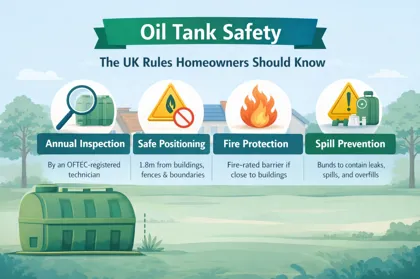
Oil Tank Safety: The UK Rules Homeowners Should Know




