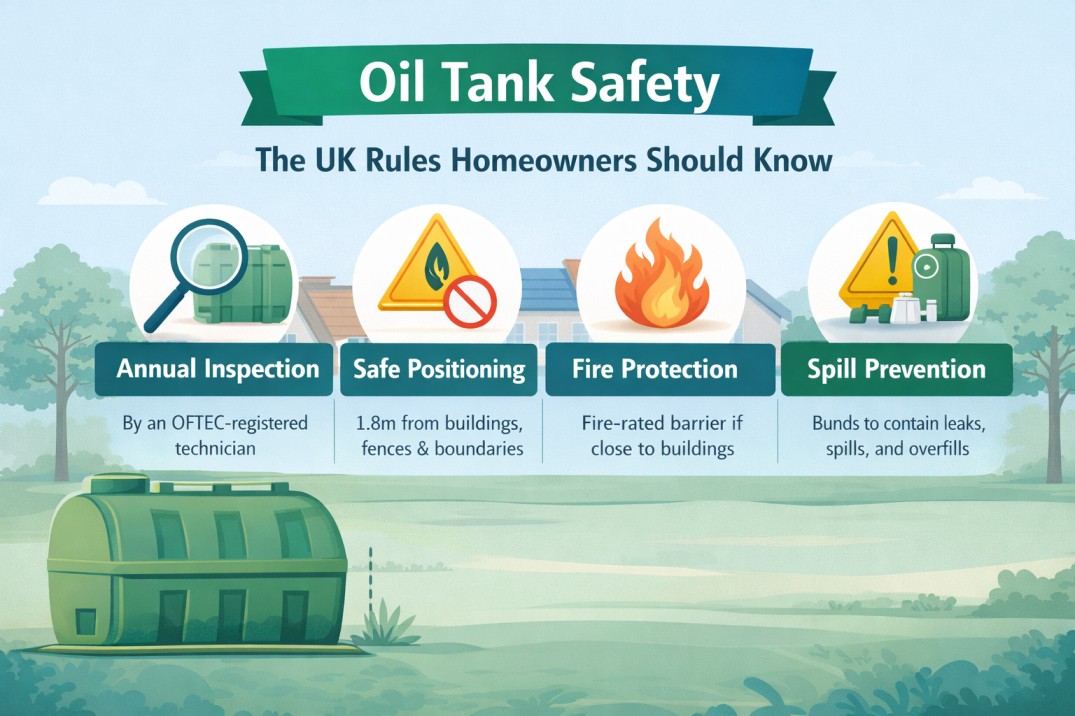

The homeowners of the UK should be aware of the processes to maintain the tank safety while using heating fuel. If the fuel tank is safe, the fuel use will be perfect. While discussing the concerns of “oil tank safety UK”, you have to understand some of the safety rules. Here, the safety rules and domestic oil tank regulations are connected to prevent the machine and related family members from damaging fuel leaks, the hazards of fire and costly kinds of repairs.
These rules are also connected to Building Regulations and OFTEC guidance. They cover the essential points, like the safety of the tank location. As per the rules, the tank should be far from the areas of fire and water. The tank should be installed by the support of professional installers. Your domestic fuel storage should also work for sustainable concerns and should go through regular checkups. All the important initiatives should be taken from the proper placement of the tank to the safe functions of the fuel machine. These initiatives will also protect you from any kind of legal issues and potential fines.
Let’s discuss in this article what measures should be taken by homeowners for oil tank safety and how they can be implemented.
Rules In Four Phases For UK Domestic Fuel Tank Safety
In the UK the people should be aware of oil tank safety rules, and they should work on using the bunded tanks that will have 110% work capacity. Let’s have an idea about other rules for tank protection in four phases under the facts of “oil tank safety UK”.
Phase 1: Rules For Locations And Tank Installations
The first thing you need to do is check how and where the tank will be installed.
Visual checks: You have to have visual checks for the tank. You have to check whether there is any development of stains in the inner and/or outer parts of the tank. The tank can have the capacity of carrying a range of fuel of 3500 litres, and for this, you have to take care that it is installed 1.8 metres away from non-fire-rated walls. The protection standard of BS 5410 should be followed. However, in some of the situations a fire-resistance wall should be installed.
Support of a professional: As per the domestic oil tank regulations, while installing the tank, you should take the support of professionals. They will better guide you about how to handle the tank. These experts should be certified by OFTEC.
Distance from ignition sources: As per the OFTEC guidance, the fuel tank should be kept far from the sources of ignition. It should be 1.8 metres away from openings like the windows and doors in a fire-rated structure. This can be like a garage and/or a brick-built house.
Distance from water: You may want to know how your domestic fuel storage should be safe from water. The tank should be stored in a place that is 10 metres away from coastal waters and/or inland. This should also be far from the areas that carry the risk of flooding.
No frontage: You should not place the tank in front of the main elevation of a house that is near a highway in the UK. The tank of fuel should be placed in a location that will not have such frontage.
Height of the tank: The capacity of the tank should be to carry fuel from 500 litres to 10,000 litres. In the houses of the UK, it can be between the amounts of 1000 litres to 2500 litres. For this, the tank height should be nearly 3 metres, and it can be less if it is near boundaries. However, here the key issues that should be focussed are the distance and separation.
Use of bunded tanks: The fuel tank that you will use should have double covers. It will protect the fuel from any kind of leaks and theft.
Phase 2: Tank Maintenance
To have better results, you have to maintain the fuel tank properly. This comes under the concerns of “oil tank safety UK”.
Temperature control: The tank should be kept far from direct sunlight. The tank should also be far from any sources of heat and sparks, and/or flames. It should be well-insulated to manage proper temperature.
Proper use: The tank should be handled well as per OFTEC guidance. You can work on using the boiler and the engine for what it has been prepared for. The fuel machine should be used for space heating and water heating.
No pumping: The domestic oil tank regulations say that the tank should not be electrically and/or manually pumped for fuel in a place where it is located, as this can lead to safety issues. The fuel lines should always be checked for any kind of blockage.
Keeping the area of the tank clear and clean: The area around the fuel tank should be cleaned and should be clear. There should not be any growth of plants, clutter and/or trees around the tank. Any kind of dirt and garbage should also be removed from its surrounding areas. The user should follow the safety rules of DSEAR.
Checks for sludge and rust: You should work on verifying that there is not any collection of debris, sludge and/or rust in and around the fuel tank. If the fuel has any collection of sludge its texture can be cloudy and/or dark. The rust can also result in holes in the fuel tank. The significant components of the fuel machine that come in the forms of vents, fuel lines etc should be kept clean.
Checks for water collection: Check whether the domestic fuel storage tank is free from any kind of collection of water. This can result in the development of corrosion. You can use various water detecting and/or finding pastes.
Protection from extreme weather conditions: The tank should also be protected from extreme conditions of weather. For example, in extreme winter, it should be protected from snowfalls and gelling and/or freezing of fuel.
Phase 3: Checks For Spills And Leaks
The fuel oil tank should also be checked for any kind of leakage. This is the basis of domestic oil tank regulations.
Containment: Whether the tank is underground and/or above ground, it should be kept on impermeable kinds of surfaces and should be away from any kinds of drains. It should follow the rules of the Control of Pollution Act. A secondary containment will work for proper control and will make it uncontaminated and intact. The tank containment is needed to become regulatory compliant.
Reporting for spills: As per the viewpoint of “oil tank safety UK”, you should make a report to the OFTEC-registered engineers and/or the Environment Agency if your fuel tank is having significant levels of fuel spills. This is needed to protect the health of the family members and the environment.
Use of tank gauges: The principles of OFTEC guidance say that you can use various forms of tank gauges and/or sensors to check the fuel and the fuel tank’s conditions. These can be either sight gauges and/or pressure gauges with digital gauges.
Use of tank telemetry and remote monitoring: You can check the fuel inside the domestic fuel storage tank by using the tank telemetry and/or remote monitoring machines. These work on the basis of cloud platforms and internet to give the real data of fuel level and fuel usages. This will make you aware of any risk and/or hazard on time, and you can work on prevention.
Phase 4: Other Significant Checklists
In the UK, as per the domestic oil tank regulations, you should also work on some other concerns to manage the fuel tank safety.
Do not hide: Do not try to hide the fuel tank of your home under any kind of sheds to protect it from any kind of inspections. The inspections are done for your tank’s safety.
Have proper ventilation: Arrange an area for the tank that will have proper ventilation. The excessive pressure should be released from it, and this will prevent the risks of bursts and/or explosion.
Protect from fuel theft and siphoning: The domestic fuel storage tank should be kept protected from any kind of fuel theft. For this, you can work with tank cages and/or arrange CCTV cameras. You can also use anti-siphoning devices.
Prevent excessive use of fuel: The excessive use of fuel should be prevented. This will reduce the chances of refilling the tank again and again, and the tank will need less maintenance.
Know about the system: When you talk about the concept of “oil tank safety UK,” you should know about your tank as a whole. You should know what metal has been used to prepare it and whether it has received an approval. This will inform you about the safety initiatives. The tanks should also have proper labeling like “PETROL” and/or “HIGHLY FLAMMABLE” etc.
Design standards of fuel containers: In the UK, the tanks that are fixed should meet some of the design standards. These standards should be related to the OST T100 of the Oil Firing Technical Association if the fuel container is prepared from plastic. The tank should be prepared to prevent any kind of hazards.
Rules for fuel tank fittings and connections: Inside the tank, the pipes should have shut-off valves, and it should meet the rules and standards of BS EN 10497 for having safety from fire. It will also work for preventing leakages.
OFTEC and British standards: Your fuel tank should also follow the OFTEC guidance and rules of British Standards. If the fuel container is of metal, you should follow the standards of OFS T200 of OFTEC and/or the British standard 799-5.
The Bottom Line
When you discuss the issues related to the viewpoint of “oil tank safety UK” in your home and/or farm, you have to be sure that you are following some certain rules. The fuel containers of your use can be in the forms of drums, tanks, and/or IBCs. You can also use mobile containers called “bowsers”.
As per the domestic oil tank regulations of the UK, the homeowners should follow the safety rules while storing the fuel tank in a shed and/or garage. The tank should also be away from heating sources and should be placed in a well-ventilated location. The tank installations should be done under OFTEC guidance. The fuel should also not be used apart from boilers and/or engines. You should be aware of all the advantages and disadvantages of the fuel tank that are made up of plastic and/or metal. A prompt kind of replacement should also be done for old and/or damaged tanks. These all initiatives together will work for protecting the soil and water from damages created by oil spills.
In short it can be said that the safety standards of domestic fuel storage have been prepared to have worry-free use of the heating machine; here, you should always check whether the procedures of tank installation and maintenance have been done in an accurate way!

You Might Like Also

Off-Grid Heating in the UK: Why 1.5 Million Homes Still Rely on Oil


What Every HGV Driver Needs to Know About DERV Fuel

How UK Businesses Are Reducing Emissions Without Changing Engines




